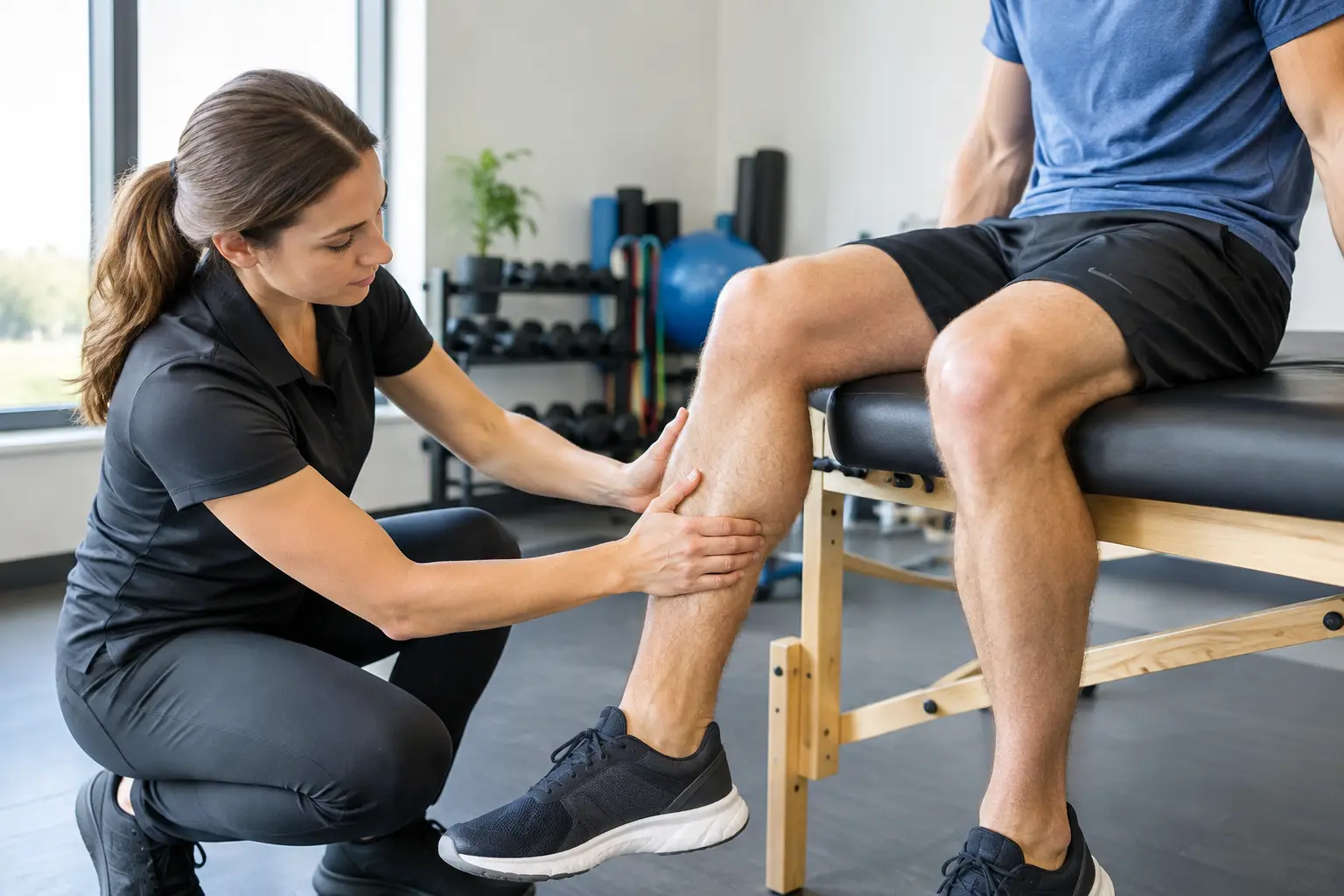
A sharp grab in the calf during a hill repeat is different from the tight, gradually worsening ache that shows up at kilometre five. Both are common forms of calf pain when running, but they do not always come from the same tissue or need the same plan. Trying to stretch through every calf problem or simply taking a few days off can leave the underlying loading issue untouched.
What calf pain when running may involve
Your calf is not one simple muscle. The gastrocnemius is the larger, more visible muscle that crosses the knee and ankle. The soleus sits underneath it and works hard during steady running, hills, and longer efforts. Both connect into the Achilles tendon and help control the ankle as you land, then push the ground away with every stride.
Calf pain running can involve a muscle strain, a gradual overload response in the soleus or gastrocnemius, Achilles tendon irritation, or a problem referred from elsewhere in the leg. Less commonly, pain in the lower leg may relate to bone stress, nerve irritation, circulation, or another medical issue. The exact location, onset, behaviour during a run, and response over the following day all matter.
A calf strain often feels sudden. Runners may describe a pop, a snap, or the sensation of being kicked in the back of the leg. Walking quickly, going upstairs, or pushing off the toes can be painful afterward. Gradual calf overload is usually less dramatic. The area may feel stiff at the beginning of a run, loosen temporarily as you warm up, then become sore or heavy later in the session or the next morning.
Common symptoms runners notice
Symptoms can range from a mild tightness to a clear loss of push-off strength. Pain higher in the calf, especially with the knee straight, may point more toward the gastrocnemius. Deeper pain lower in the calf that is aggravated by bent-knee running, hills, or longer distances may involve the soleus. Achilles-related pain is usually closer to the tendon just above the heel, often with morning stiffness.
Some runners only notice discomfort at faster paces. Others can jog comfortably but flare up with hills, stairs, speed work, or a return to court sports. Bruising, swelling, tenderness to touch, reduced ankle movement, and an inability to perform repeated single-leg calf raises are all useful clues during an assessment. They do not, on their own, confirm a diagnosis.
Why calf pain develops during running
The calf has a major job in running. It absorbs load as your body moves over the foot and generates force for propulsion. That demand rises with speed, hills, intervals, trail running, sudden changes in footwear, and races or long runs added before the body is ready.
The most common driver is a mismatch between training load and current tissue capacity. That can look like increasing weekly mileage quickly, restarting after time off, adding hill repeats to an otherwise flat program, or doing hard lower-body gym sessions alongside faster running. It can also happen after a previous ankle, Achilles, hamstring, or calf injury when strength and confidence never fully returned.
Running mechanics can contribute, but they are rarely the only explanation. A runner who lands more on the forefoot may place more demand on the calf-Achilles complex. Limited ankle motion, poor tolerance to single-leg loading, and fatigue later in a run can all change how the calf is loaded. The goal is not to find one “bad” movement pattern. It is to identify the combination of factors your calf currently cannot tolerate.
What commonly aggravates calf pain running
Speed work, hills, and uneven terrain tend to expose calf problems quickly. A faster stride requires more force from the calf, while uphill running keeps the ankle working through greater ranges. Cold starts can also feel worse because a stiff or irritated calf may need more time to tolerate load.
Complete rest can settle symptoms in the short term, but it is not always enough to prepare the tissue for running again. On the other hand, forcing painful runs because the calf loosens after ten minutes can turn a manageable overload problem into a longer interruption. The useful middle ground depends on your symptoms, function, and the type of injury.
When calf pain needs prompt assessment
A sudden, severe calf injury with swelling, bruising, or difficulty walking should be assessed rather than tested with another run. The same applies if you felt a pop or cannot push off normally. Early assessment helps clarify whether you are dealing with a significant muscle injury, Achilles involvement, or something else that changes the rehabilitation plan.
Seek urgent medical attention for calf pain with unexplained significant swelling, warmth, redness, skin colour changes, shortness of breath, chest pain, or feeling unwell. These symptoms can have causes beyond a running injury and should not be managed as routine muscle tightness.
For the more common gradual presentation, an assessment is worthwhile if pain keeps returning, alters your stride, limits your running volume, or has not improved despite sensible adjustments. Recurring calf pain is often a sign that the runner has addressed symptoms but not rebuilt capacity.
How calf pain is assessed
A good assessment starts with the story. When did the pain start? Was there a specific moment? What has changed in your training, shoes, terrain, gym work, work demands, or recovery? We then look at how the leg performs, not just where it is tender.
This may include checking ankle and knee movement, calf strength with straight- and bent-knee calf raises, balance, hopping tolerance when appropriate, walking and running mechanics, and the response to loaded movements. Comparing sides is useful, but the unaffected side is not always an ideal benchmark if both legs have been undertrained for current running demands.
The assessment also helps separate a calf muscle issue from Achilles tendon pain, shin-related pain, nerve symptoms, or a problem referred from the low back. If the findings suggest imaging or medical assessment is needed, that should be part of the plan.
Treatment and rehabilitation for calf pain
Treatment should match the presentation. In a recent strain, the first priority may be reducing aggravation while keeping safe movement in the program. In a gradual overload problem, the focus is often on finding a tolerable level of activity rather than stopping everything.
Hands-on treatment can be useful when pain, guarding, or restricted movement is making it hard to load the area well. Depending on the assessment, this may include deep soft tissue therapy, instrument-assisted soft tissue work, joint treatment, or mobility work. These approaches can help symptoms and movement, but they are not the whole solution. The calf still needs progressive exposure to force.
For persistent tendon-related symptoms or stubborn calf-Achilles presentations, shockwave therapy or Class IV laser therapy may be considered as part of a broader plan. They are adjuncts, not stand-alone cures. Their value depends on the diagnosis, irritability, time course, and whether the rehabilitation program is progressing appropriately.
Progressive loading is the return-to-running foundation
Rehabilitation usually begins by restoring comfortable calf function, then building strength and endurance. This can include controlled calf raises with the knee straight and bent, followed by heavier loading, faster repetitions, and eventually hopping or running-specific drills when appropriate. The gastrocnemius and soleus need different emphasis because running demands both.
The next step is not automatically a full return to previous mileage. A runner may start with short, flat, easy runs or a run-walk structure, then progress distance before adding hills, speed, or back-to-back harder sessions. Symptoms during the run matter, but so does how the calf feels later that day and the following morning. A small, settled response may be acceptable in some cases. Escalating pain, worsening stiffness, or declining function means the plan needs adjustment.
Strength work does not need to replace running forever. It is a way to raise the calf's capacity so normal training is less likely to exceed it. The right dosage depends on whether you are preparing for a 5K, returning to recreational running, working long shifts on your feet, or balancing running with heavy gym training.
A practical approach at Ground Up Rehab
At Ground Up Rehab in Hamilton, calf pain is approached as a running and loading problem, not just a tight muscle to rub out. Care begins with a detailed assessment to identify the most likely source of symptoms and the factors keeping it going. From there, hands-on treatment may be used to improve comfort and movement while a progressive rehabilitation plan restores calf strength, running tolerance, and confidence.
The plan should fit your actual goal. Returning to a weekly social run requires a different progression than getting ready for the Around the Bay Road Race, competitive sport, or a physically demanding job. More treatment is not automatically better. The target is meaningful improvement in what your calf can do between appointments.
If your calf keeps tightening, aching, or grabbing when you run, book an assessment to get clear on what is driving it and build a plan that gets you back to training with more confidence.
